
Download
Original Article
Fermented sour wort enriched with Pediococcus acidilactici PA-2 as a natural marinade to reduce Listeria monocytogenes and Salmonella Typhimurium in raw chicken
Basobi Mukherjee1,2, Farzana Nishat1, Saber Amiri3, Amin Yousefvand1,4*, Per E. J. Saris1
1Department of Microbiology, Faculty of Agriculture and Forestry, University of Helsinki, Helsinki, Finland;
2Department of Biochemistry and Microbiology, Faculty of Food and Biochemical Technology, University of Chemistry and Technology, Prague, Czech Republic;
3Department of Food Science and Technology, Urmia University, Urmia, Iran;
4Helsinki Institute of Sustainability Science (HELSUS), University of Helsinki, Helsinki, Finland
Abstract
Raw chicken, valued for its affordability and nutritional benefits, remains vulnerable to contamination by meat-borne pathogens despite advances in food safety systems. Biopreservation using lactic acid bacteria, particularly pediocin-producing Pediococcus acidilactici, offers a natural strategy to inhibit foodborne pathogens through the production of lactic acid and bacteriocin. This study aimed to evaluate the antimicrobial effect of sour wort fermented with P. acidilactici PA-2 as a natural marinade against Listeria monocytogenes and Salmonella -typhimurium in raw chicken. Sour wort was prepared and fermented with P. acidilactici PA-2 at 30°C for 24 h and 48 h, reaching final cell counts of 8.0 and 8.5 log10 CFU/g, respectively, and pH values between 3.8 and 4.5. Raw chicken samples were inoculated with approximately 6.9 log10 CFU/mL of L. monocytogenes and 6.4 log10 CFU/mL of S. typhimurium, marinated with 24-h and 48-h fermented wort (Ringer’s solution as control), and stored at 4°C for 16 h. On selective media, pathogen populations were enumerated. Both 24-h and 48-h fermented wort marinades significantly reduced L. monocytogenes and S. typhimurium counts compared with the control (p < 0.05). The 48-h fermented wort reduced L. monocytogenes and S. typhimurium counts by 1.9 and 1.8 log10 CFU/g, respectively, while the 24-h wort produced similar reductions of 1.7 and 1.8 log10 CFU/g. No significant differences were observed between the two fermentation times (p > 0.05). These findings suggest that P. -acidilactici PA-2 fermented sour wort can serve as an effective clean-label marinade that enhances the microbiological safety of raw chicken during short-term refrigerated storage, contributing to reduced foodborne risk without relying on chemical preservatives.
Key words: biopreservation, sour wort, chicken meat, Pediococcus acidilactici, Listeria monocytogenes, marinade, Salmonella typhimurium
*Corresponding author: Amin Yousefvand, Department of Microbiology, Faculty of Agriculture and Forestry, University of Helsinki, P.O. Box 56, FI-00014 Helsinki, Finland. Email: [email protected]
Academic Editor: Carlos A.F. Oliveira, PhD, Department of Food Engineering, School of Animal Science and Food Engineering, University of São Paulo, Brazil
Received: 27 May 2025; Accepted: 25 February 2026; Published: 23 March 2026
© 2026 Codon Publications
This is an Open Access article distributed under the terms of the Creative Commons Attribution-NonCommercial-ShareAlike 4.0 International (CC BY-NC-SA 4.0). License (http://creativecommons.org/licenses/by-nc-sa/4.0/)
Introduction
Biopreservation is the use of naturally occurring -microorganisms or their metabolites to inhibit the growth of spoilage microorganisms and pathogens in food products (Kaveh et al., 2023). In the recent decade, the application of bio-preservatives in the food industry has increased gradually due to consumer demand (Amiri et al., 2022). Lactic acid bacteria (LAB) are the most commonly used biopreservatives owing to their ability to produce antimicrobial compounds such as organic acids, hydrogen peroxide, and bacteriocins, which can drastically reduce pathogen loads in various food matrices, including chicken (Amiri et al., 2022). Chicken is a popular protein source across the world, known for its affordability and nutritional potential. According to reports, the most consumed meat worldwide is poultry meat, with approximately 140 million tons consumed in 2023 (Statista, 2024). Poultry meat provides a suitable environment for microbial growth, which poses significant challenges for food safety. Long-term storage at refrigeration temperatures (4ºC) is not possible (Göçmez and İlhak, 2025; Serter et al., 2024).
The presence of foodborne pathogens in poultry products is a major public health concern. In particular, listeriosis and salmonellosis are notorious foodborne diseases that continue to pose significant challenges to national economies and public health across the globe. Presently, the primary source of human infection is the consumption of contaminated raw or undercooked poultry meat and their products (Abatcha, 2017). L. monocytogenes is particularly dangerous since it is ubiquitous, halophile, capable of forming biofilms, and can thrive at refrigeration temperatures, while Salmonella enterica subsp. enterica and its numerous serotypes cause severe gastrointestinal illness (Seo and Kang, 2020).
Natural preservatives are becoming more popular than chemical alternatives as consumers’ awareness of healthy eating has grown (Gargi and Sengun, 2021; Göçmez and İlhak, 2025; Karatepe et al., 2025). Marinades, which are commonly made with acidic substances, herbs, and spices, not only improve flavor but also have antibacterial characteristics that help limit the growth of foodborne pathogens. The use of marinades based on natural ingredients is increasingly being investigated as a means of improving the shelf-life and safety of meat products, in line with customer aspirations of clean label options (Latoch et al., 2023; Rahman et al., 2023). Nowdays, marinades are widely used in both households and the food industry because of the beneficial properties they provide to meat.
Researchers are focusing on the use of natural antimicrobial compounds such as bacteriocins due to concerns about chemical preservatives. Bacteriocins are ribosomally synthesized peptides or proteins produced by gram-positive and gram-negative bacteria (Khorshidian et al., 2021). The most studied bacteriocins that could be utilized commercially as natural preservatives are nisin and pediocin (Khorshidian et al., 2021). Currently, nisin is the only bacteriocin that can be used as an authorized additive (Khorshidian et al., 2021). Some Pediococcus bacteria produce pediocins, which are small unmodified peptides with a low molecular weight (2.7–17 kDa) and belong to subclass IIa of bacteriocins (Khorshidian et al., 2021). Pediocin and pediocin-like bacteriocins exert antimicrobial activity, especially against L. monocytogenes through formation of pores in the cytoplasmic membrane, causing cell membrane dysfunction, inhibition of protein synthesis, and gene expression (Khorshidian et al., 2021). The current application of Pediocin PA-1 in the food industry highlights the biopreservative potential of pediococci, leading to further studies to characterize novel strains and pediocin variants that can be used in food systems to ensure quality and safety (Todorov et al., 2022). Accordingly, P. acidilactici has emerged as a viable option among the different microbial agents investigated for their potential in food preservation (Barbosa et al., 2015; Todorov et al., 2022). The bacteriocins of P. acidilactici are effective anti-biofilm agents to control S. typhimurium contamination in chicken and food-processing facilities (Seo and Kang, 2020). Incorporating P. acidilactici into marinades may increase their bactericidal activities against pathogens such as L. monocytogenes and S. typhimurium, enhancing the microbiological safety of raw chicken (Barbosa et al., 2015; Latoch et al., 2023; Rahman et al., 2023).
Several studies have demonstrated that marinades containing organic acids and bacteriocins can effectively reduce populations of Salmonella and Listeria in raw chicken (Göçmez and İlhak, 2025; İncili et al., 2020; Meneses and Teixeira, 2022). The bactericidal effect is due to the ability of these acids and bacteriocins such as pediocins to permeate bacterial membranes, dissipate proton motive force, prevent energy production, inhibit glucose uptake, inhibit the synthesis of nucleic acids, disrupt cellular functions, and eventually lead to cell death (Latoch et al., 2023; Lopes et al., 2022).
Although the antimicrobial effects of LAB and their bacteriocins, including pediocin produced by P. acidilactici, have been demonstrated in various food systems, there is limited research on the use of sour wort fermented specifically with P. acidilactici PA-2 as a natural marinade for raw poultry meat. Our study aims to fill this gap by evaluating the antimicrobial effect of sour wort fermented with P. acidilactici PA-2 as a natural marinade for raw chicken. Specifically, we assessed the ability of 24-h and 48-h fermented wort marinades to reduce populations of L. monocytogenes and S. typhimurium on inoculated chicken meat during 16 h of refrigerated storage at 4ºC, in order to determine their potential to enhance the microbiological safety of -marinated chicken.
Materials and Methods
Bacterial cultures
Experiments were performed using P. acidilactici PA-2 SAA 262 (Chr. Hansen, Hørsholm, Denmark), L. monocytogenes WSLC 1018, and S. typhimurium ATCC 23852 (American Type Culture Collection). Cultures were stored at −80ºC and resuscitated by inoculating P. acidilactici in de Man, Rogosa, Sharpe (MRS; Oxoid, Basingstok, Hampshire, UK) broth, L. monocytogenes in Brain Heart Infusion (BHI; LabM, Lancashire, UK) broth, and S. typhimurium in Luria-Bertani (LB; Merck) broth; inoculated cultures were then incubated at 30ºC or 37ºC overnight. For the L. monocytogenes and S. typhimurium strain, a loopful of culture broth was inoculated into 10 mL of fresh BHI and LB broth, respectively, and incubated at 37ºC overnight to obtain fresh culture.
Raw chicken
Fresh raw chicken was purchased from the local market on the day of the experiment, which was the same source throughout the study. Chicken meat samples were transported under good hygienic conditions to the laboratory within 30 min of purchase. Using a sterilized knife, the chicken was manually cut into approximately 25 g cubes.
Wort preparation
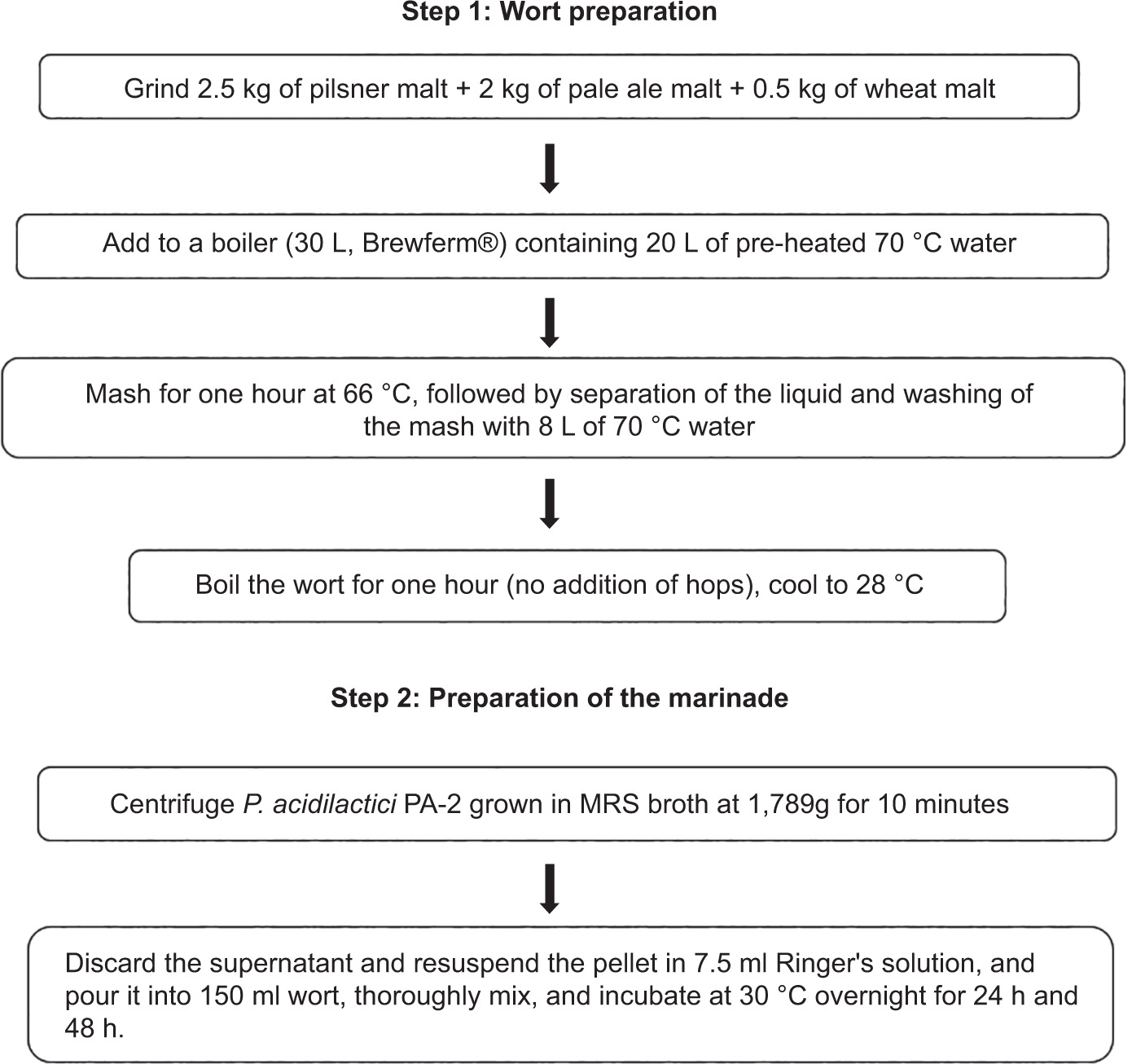
Malt, 2.5 kg of pilsner malt, 2 kg of pale ale malt, and 0.5 kg of wheat malt (Viking malt, Lahden Polttimo Ltd., Lahti, Finland) were ground and added to a boiler (30 L, Brewferm®) containing 20 L of preheated 70ºC water. Mashing was done for 1 h at 66ºC, followed by separation of the liquid and washing of the mash with 8 L of 70ºC water. Thereafter, the wort was boiled for 1 h (no addition of hops), cooled to 28ºC, and used as the growth medium for the chosen bacteria to yield sour wort (Figure 1).
Figure 1. Illustration of the experimental procedure.
Preparation of the marinade
The enumeration of P. acidilactici was carried out in 10 mL of de MRS broth and incubating at 37ºC for 48 h. After incubation, P. acidilactici PA-2 grown in MRS broth was transferred to a centrifuge tube and centrifuged at 1,789 g for 10 min. The supernatant was discarded, and the pellet was resuspended in 7.5 mL Ringer’s solution, which was then poured into 150 mL wort, thoroughly mixed, and incubated at 30ºC overnight for 24 h and 48 h (Figure 1). The initial concentration of P. acidilactici PA-2 in the wort before incubation was 5.0 log10 CFU/mL. After 24 and 48 h of fermentation at 30ºC, the PA-2 count was 8.0 log10 CFU/mL and 8.5 log10 CFU/mL, respectively.
pH determination
The pH of the fermented wort was measured using a pH meter, specifically the Thermo Orion Model-420A'. An electrode was inserted directly, and measurements were taken in triplicate; averages over the triplicates were used in subsequent analyses.
Experimental groups
Chicken samples were assigned to three groups (Table 2):
Group 1: Control group marinated with Ringer’s solution.
Group 2: Chicken meat marinated with 24-h fermented sour wort containing P. acidilactici PA-2.
Group 3: Chicken meat marinated with 48-h fermented sour wort containing P. acidilactici PA-2.
Table 1. Selected studies on antimicrobial marinades in chicken and their effects.
| Study | Matrix | Target pathogens | Marinade | Storage conditions | Main antimicrobial effect (log10 CFU/g) |
|---|---|---|---|---|---|
| Fouladkhah et al., 2013 | Chicken | L. monocytogenes | Lemon juice–based marinades | Up to 7 days at 4°C | About 2.0 log10 CFU/g reduction |
| İncili et al., 2020 | Chicken | S. typhimurium | Marinade sauce | 24 h at refrigeration temperature | About 4.0 log10 CFU/g reduction |
| Sengun et al., 2019 | Chicken | S. typhimurium | Koruk (Vitis vinifera L.) juice marinade | 18 h at refrigeration temperature | About 3.5 log10 CFU/g reduction |
| Eldin et al., 2020 | Chicken | Salmonella spp. | Lemon juice (50–100%) | Up to 6 days at 4°C | About 3.0 log10 CFU/g reduction depending on lemon juice concentration |
| Li et al., 2023 | Chicken | L. monocytogenes | Beer with leucocin C | Short-term marination under refrigeration | About 1.6 log10 CFU/g reduction using bacteriocin-secreting yeast |
| Göçmez and İlhak, 2025 | Chicken | Salmonella spp. | Bioprotective culture marinades | Up to 14 days at 4°C | About 2.3 log10 CFU/g reduction |
| Present study | Chicken | L. monocytogenes, S. typhimurium | Pediococcus acidilactici PA-2 fermented sour wort | 16 h at 4°C | 1.7–1.9 log10 CFU/g reduction of both pathogens |
Table 2. Experimental groups stored at 4ºC for 16 h.
| Groups | Treatment |
|---|---|
| Group 1 | Control group marinated with Ringer’s solution. |
| Group 2 | Chicken meat marinated with 24-h fermented sour wort. |
| Group 3 | Chicken meat marinated with 48-h fermented sour wort. |
Microbiological analysis
A total of 25 g of raw chicken meat was placed in stomacher bags with integrated filters. Subsequent decimal dilutions of BHI broth containing L. monocytogenes and LB broth containing S. typhimurium were performed in Ringer’s solution as required, and 10 mL of the sixth dilution of each broth was added to separate stomacher bags. The initial inoculation levels of L. monocytogenes and S. typhimurium at time zero was 6.9 log10 CFU/mL and 6.4 log10 CFU/mL, respectively. The spiked samples were placed in a stomacher lab-blender 400 and blended at 230 rpm for 2 min, then incubated for 30 min at room temperature. Next, wort with P. acidilactici PA-2 was added to each stomacher bag of L. monocytogenes and S. typhimurium and blended again in the laboratory blender. Ringer’s solution (150 mL) was used instead of wort as a negative control. All samples were stored at 4ºC for 16 h. Following incubation, the samples were mixed again using the stomacher lab-blender. Decimal dilutions were performed and spread plated (100 µl) onto xylose lysine deoxycholate (XLD) (for Salmonella) and Oxford agar (for Listeria). Plates were incubated at 37ºC for 18–24 h (XLD) or 40–48 h (Oxford) before typical colonies were enumerated. The resulting data were transformed to log10 CFU/g. All the above treatments were performed in triplicate. The single storage scenario of 4ºC for 16 h was chosen to simulate common consumer refrigeration duration for marinated poultry that may be consumed within 1 day after preparation.
Statistical analysis
Microbial counts were analyzed in triplicate. The data collected for evaluating microbial content was subjected to analysis of variance (ANOVA) using the general linear model procedure. The results are presented as mean values with their respective standard deviations. Tukey’s test was used to identify significant differences between means, with a predetermined level of statistical significance set at p ≤ 0.05. All statistical analyses were performed using Minitab 21.4 software (Minitab Inc., State College, PA, USA).
Results
pH determination
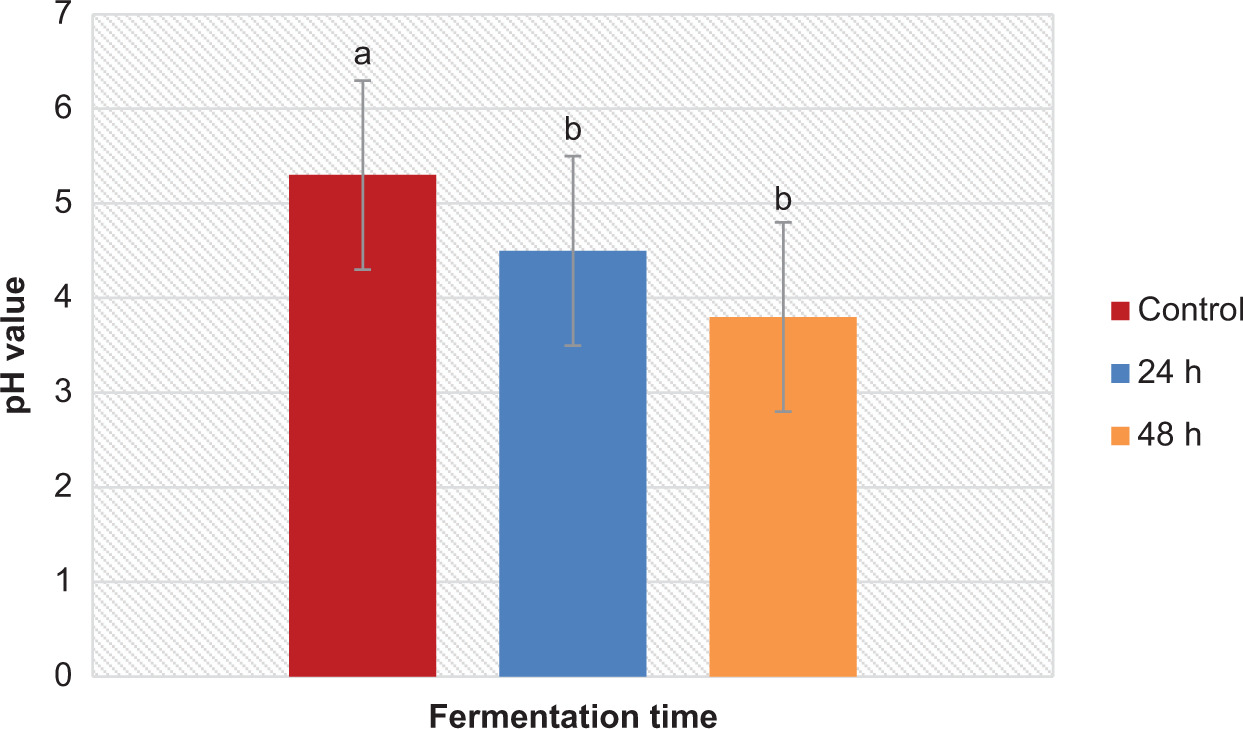
The pH values of the wort after 24 h and 48 h of fermentation were 4.5 and 3.8, , respectively, and without P. acidilactici PA-2, the wort pH was 5.3 (Figure 2).
Figure 2. pH values of marinade groups with P. acidilactici PA-2 (24 h and 48 h fermentation) and control. Lowercase letters denote significant differences (p < 0.05) between samples at the same storage timepoint.
L. monocytogenes
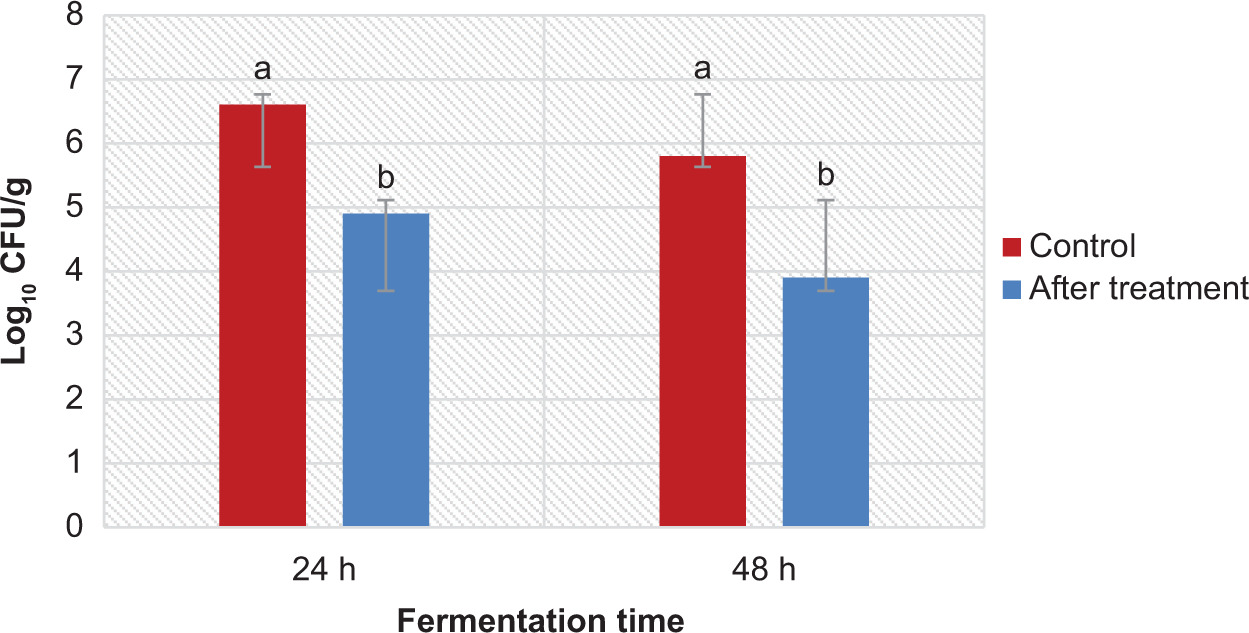
The viable count of L. monocytogenes declined in chicken meat marinated with fermented wort compared to the unmarinated meat sample. The initial inoculation level of L. monocytogenes in chicken meat prior to marination was approximately 6.9 log10 CFU/mL. After 16 h of refrigerated storage, L. monocytogenes count in untreated meat was 6.6 log10 CFU/g (p < 0.05) for 24 h and 5.8 log10 CFU/g (p < 0.05) for 48 h. In contrast, marination with wort fermented by P. acidilactici PA-2 for 24 h was 4.9 log10 CFU/g, resulting in a significant reduction of 1.7 log10 CFU/g in L. monocytogenes counts compared to the control group marinated with Ringer’s solution (p < 0.05). Similarly, 48-h fermented wort marinade was 3.9 log10 CFU/g, showing a significant reduction of 1.9 log10 CFU/g in L. monocytogenes counts compared to the control group marinated with Ringer’s solution (p < 0.05). Statistical analysis (ANOVA) showed no significant difference between reductions achieved by 24-h and 48-h fermentation treatments (p > 0.05) (Figure 3).
Figure 3. Log reduction in Listeria monocytogenes counts in raw chicken meat marinated with wort fermented for 24 h or 48 h and subsequently stored for 16 h at 4 ºC, relative to the control group marinated with Ringer’s solution. Lowercase letters denote significant differences (p < 0.05) between samples at the same storage timepoint.
S. typhimurium
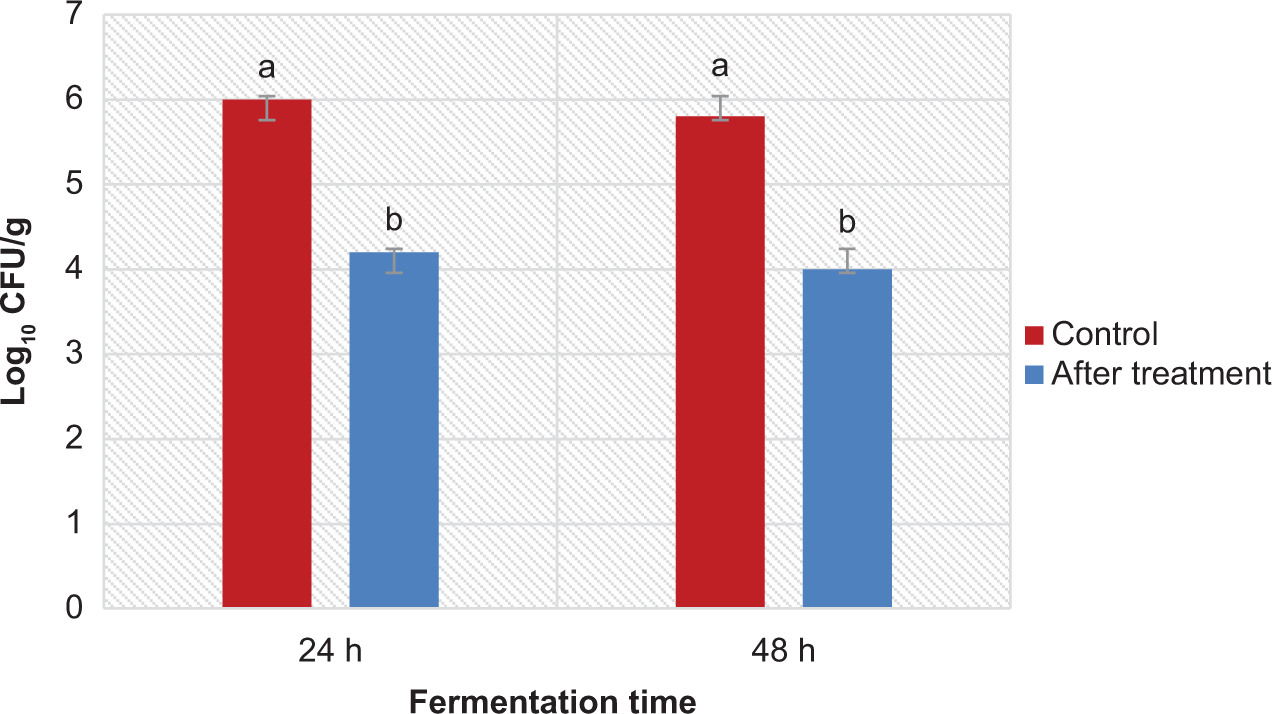
The viable count of S. typhimurium declined in chicken meat marinated with fermented wort compared to the unmarinated meat sample. The initial inoculation level of S. typhimurium in chicken meat prior to marination was approximately 6.4 log10 CFU/mL. After 16 h of refrigerated storage, S. typhimurium count in untreated meat was 6.0 log10 CFU/g (p < 0.05) for 24 h and 5.8 log10 CFU/g (p < 0.05) for 48 h. In contrast, marination with wort fermented by P. acidilactici PA-2 for 24 h was 4.2 log10 CFU/g., resulting in a significant reduction of 1.8 log10 CFU/g in S. typhimurium counts compared to the control group marinated with Ringer’s solution (p < 0.05). Similarly, 48 h fermented wort marinade was 4.0 log10 CFU/g, showing a significant reduction of 1.8 log10 CFU/g in S. typhimurium counts compared to the control group marinated with Ringer’s solution (p < 0.05). Statistical analysis (ANOVA) showed no significant difference between reductions achieved by 24 h and 48 h fermentation treatments (p > 0.05) (Figure 4).
Figure 4. Log reduction in Salmonella Typhimurium counts in raw chicken meat marinated with wort fermented for 24 h or 48 h and subsequently stored for 16 ºC at 4 ºC, relative to the control group marinated with Ringer’s solution. Lowercase letters denote significant differences (p < 0.05) between samples at the same storage timepoint.
Discussion
The antimicrobial efficacy of marinades is influenced by several factors, including low pH, organic acids, and other metabolites produced during fermentation by LAB such as P. acidilactici. This species is known to produce the bacteriocin pediocin with strong antilisterial activity, although pediocin production and activity are not always directly quantified in fermentation studies. Low pH is generally considered a major contributor to microbial inhibition in marinades (Göçmez and İlhak, 2025). The observed decrease in pH of the wort from 5.3 to 4.5 after 24 h and 3.8 after 48 h fermentation confirms strong acidification by P. acidilactici PA-2 in this matrix, consistent with reports that LAB, including P. acidilactici, reduce pH during fermentative growth in food systems (Kaveh et al., 2023; Othman et al., 2018). In general, larger reductions were observed when marinades with a pH of < 4.5 were used, regardless of the other ingredients present in the marinade and the food matrix (Lopes et al., 2022 Fisher et al., 2016). The low pH was identified as the most pronounced parameter, affecting the inactivation of pathogens in marinades; however, some effects of the ingredients and storage temperature cannot be completely ruled out (Lopes et al., 2022). A lower pH does not necessarily positively affect meat tenderness and moisture content (Rahman et al., 2023).
In our study, the use of pediocin-producing P. acidilactici strain in marinades was highly effective in reducing L. monocytogenes and S. typhimurium on chicken meat under refrigerated conditions. Marinade made with P. acidilactici PA-2 grown in the wort for 48 h was most effective at inhibiting growth of L. monocytogenes on chicken meat. According to Kho et al. (2024), antimicrobial activity of cell-free supernatants from P. acidilactici was detected early at 12 h of incubation and gradually increased, peaking around the late stationary phase at 48 h. In a related study, Fouladkhah et al. (2013) concluded that the number of L. monocytogenes increased significantly in the control group while the lemon juice marinated groups decreased by 2 log10 CFU/g after 7 days, analogous to that of the present study. According to Nyhan et al. (2018), L. monocytogenes has strong resistance to low temperature, pH, and water activity. However, the findings of Rhoades et al. (2013) suggested that bacteria cannot be inactivated by pH alone—the dissociation rate of acid-producing substances also plays a role. Citric acid in lemon juice has a low undissociated acid rate and has been shown to inhibit the growth of L. monocytogenes (Wemmenhove et al., 2016). These results are in accordance with those of the present study. In addition, our findings are consistent with previous research on the inhibition of L. monocytogenes by pediocin PA-1 on chicken meat, which found a reduction close to 3.8 log10 CFU/g (Kiran and Osmanagaoglu, 2014; Xia et al., 2023; Zawiasa and Olejnik-Schmidt, 2025). Nieto-Lozano et al. 2010 revealed the importance of storage temperature in the use of bacteriocins. These findings highlighted that the inhibition of L. monocytogenes was more effective at 4ºC. Therefore, the strain producing pediocin PA-1, P. acidilactici MCH14, can be used in refrigerated products, as was also seen from in study.
S. typhimurium is a major serotype responsible for distressing public health concerns worldwide. Our study showed that marinades prepared with P. acidilactici PA2 fermented wort (24 h and 48 h) were equally effective in inhibiting S. Typhimurium. Similar to this finding, İncili et al. (2020) found that the marinade sauce reduced the quantity of S. typhimurium by 4.0 log10 CFU/g after 24 h. Similarly, Sengun et al. (2019) observed that S. typhimurium count dropped 3.47 log10 CFU/g in marination sauce derived from koruk (Vitis vinifera L.) juice after 18 h. Pathania et al. (2010) also reported a drop in S. typhimurium count by 0.9 log10 CFU/g in a teriyaki marinade after 24 h. In another study by Eldin et al. (2020), it was mentioned that marinating chicken fillets with 50% and 100% lemon juice reduced Salmonella levels by 2.0 and 3.0 log10 CFU/g, respectively, when kept at 4ºC for 6 days. These findings are consistent with the current investigation. Seo and Kang (2020) disclosed that bacteriocin derived from P. acidilactici can inhibit the biofilm formation of S. typhimurium in chicken meat, suggesting that it is a promising anti-biofilm agent to prevent issues with contamination into the food chain environments.
The statistical analysis (ANOVA) indicated no significant difference (p < 0.05) between the reductions achieved by 24-h and 48-h fermentation treatments for both L. monocytogenes and S. typhimurium. This finding suggests that the shorter fermentation duration of 24 h is sufficient to reach effective microbial reduction, with no additional benefit observed by extending fermentation to 48 h. Such results highlight the efficiency of the fermentation process within a relatively short timeframe, which could be advantageous for industrial applications by reducing processing time and cost.
The magnitude of L. monocytogenes reduction observed in our study (approximately 1.7–1.9 log10 CFU/g) is comparable to or greater than reductions reported for other marinades applied to chicken meat, where decreases of about 1.6–2.0 log10 CFU/g were achieved (Fouladkhah et al., 2013; İncili et al., 2020; Meneses and Teixeira, 2022). Specifically, the viable cells of L. monocytogenes decreased by approximately 1.6 log10 CFU/g after being marinated in beer containing leucocin C. Our study demonstrated more effective results; after treating chicken with the marinade containing P. acidilactici PA-2, the L. monocytogenes counts were reduced by approximately 1.9 log10 CFU/g. However, it is necessary to select pediocin-producing strains based on the food matrix to ensure adequate bacteriocin production, as highlighted in previous studies (Khorshidian et al., 2021). Furthermore, it has been noted that marinades containing different ingredients have different antimicrobial effects on the meat’s microbiota, and gram-negative bacteria are more sensitive to acidic conditions than gram-positive bacteria. In contrast, our study showed similar magnitude of reductions in L. monocytogenes and S. typhimurium (1.8–1.9 log10 CFU/g) relative to the control group marinated with Ringer’s solution, indicating comparable sensitivity of both pathogens to acidic conditions provided by the fermented wort marinade.
The sour wort produced by the P. acidilactici strain used in this study was able to exert an inhibitory effect against L. monocytogenes and S. typhimurium after 16 h storage at 4ºC on raw chicken meat. The sour wort matrix not only provides a nutrient-rich environment that facilitates the growth of P. acidilactici but also promotes the production of its metabolites, enhancing antimicrobial activity (Othman et al., 2018). Our results indicate that using sour wort as a marinade offers a promising alternative to traditional LAB-based marinades, with additional benefits in flavor and preservation (Kho et al., 2024). This highlights the potential of sour wort to improve both antimicrobial efficacy and sensory qualities in marinated products. Regarding the influence of marinades’ temperatures on the bacterial effect, the studies that evaluated the same scenario at different marinade temperatures showed different results (Lopes et al., 2022). Considering that these reductions may not be sufficient to eliminate all pathogens present in meats, the use of high-quality meats coming from industries with good hygiene practices is very important. Furthermore, it is also recommended to use effective heat treatment before the consumption of marinated meats in order to ensure food safety (Lopes et al., 2022).
These findings support the efficacy of fermented marinades in inhibiting foodborne pathogens and align with previous research showing similar reductions (1.0–2.0 log10 CFU/g) in marinated meats (Meneses and Teixeira, 2022; Rahman et al., 2023). Fermentation-based marinades, particularly those maintaining low pH and low temperature, consistently achieve an average of 1.0–2.0 log10 CFU/g reduction in foodborne pathogens, but the effect is rarely absolute and should not be relied upon solely for food safety (Meneses and Teixeira, 2022).
Although our study demonstrates the promising antimicrobial effects of fermented wort marinade enriched with P. acidilactici against L. monocytogenes and S. typhimurium, some limitations should be acknowledged. The antimicrobial activity of P. acidilactici and its bacteriocin pediocin can vary depending on various factors such as bacteriocin concentration, strain variation, and environmental conditions including temperature and pH (Khorshidian et al., 2021). Furthermore, the stability and activity of bacteriocins in complex food matrices like chicken meat may be affected by proteolytic enzymes and interactions with food components (Khorshidian et al., 2021). Our study did not measure pH of the chicken–wort mixture after marination, though the buffering capacity of chicken meat can influence antimicrobial effectiveness (Göçmez and İlhak, 2025). In addition, while fermented wort marinades reduced pathogen counts significantly, reductions were incomplete, highlighting the importance of using good-quality meat and proper cooking for safety (Lopes et al., 2022). Lastly, the long-term stability and sensory impact of fermented wort marinades during extended storage were not assessed but should be examined in future studies. Addressing these limitations with further research will better define the practical application and optimization of P. -acidilactici–enriched fermented marinades for enhancing the safety and quality of poultry meat.
Conclusions
This study found that using fermented wort marinade enriched with P. acidilactici leads to an inhibitory effect against L. monocytogenes and S. typhimurium, thereby improving the quality and safety of chicken meat. This marinade could serve as a potential cost--effective alternative to chemical preservatives. Marinating chicken with fermented wort substantially suppresses the growth of L. monocytogenes and S. typhimurium during storage and can therefore be used as an effective technique that minimizes the risk of foodborne illness in refrigerated products. However, the efficacy of fermented wort marinades is influenced by factors such as the composition of the wort and fermentation conditions, as variable fermentation can lead to varied antimicrobial effects. While marinades can inhibit certain pathogens, improper fermentation conditions may allow the survival and growth of spoilage organisms, or even pathogens, especially if pH and temperature are not strictly maintained.
Further studies should focus on investigating the impact of fermented wort marinade on other foodborne pathogens, such as Campylobacter spp., Escherichia coli (EHEC), and Staphylococcus aureus to establish broader food safety benefits. The effect of this marinade on the shelf-life and spoilage microbiota of chicken meat should be evaluated in future studies. In addition, future research should assess the feasibility of scaling up the use of fermented wort marinades in commercial meat processing.
Mandatory Disclosure on Use of Artificial Intelligence
The authors declare that no AI-assisted tools were used in the preparation of this manuscript.
Authors Contribution
Basobi Mukherjee was involved in writing—review and editing, writing—original draft, visualization, validation, methodology, investigation, formal analysis, and conceptualization. Farzana Nishat was responsible for writing—review and editing, methodology, investigation, and conceptualization. Saber Amiri looked into writing—review and editing, investigation, and conceptualization. Amin Yousefv was responsible for writing—review and editing, supervision, project administration, methodology, and conceptualization. Per E.J. Saris was in charge of writing—review and editing, supervision, project administration, funding acquisition, and conceptualization.
Acknowledgments
Open access funding is covered by the Helsinki University Library.
Conflicts of Interest
The authors declare no conflict of interest that could have appeared to influence the work reported in this paper.
Funding
This research received no specific grant from any funding agency in the public, commercial, or not-for-profit sectors.
REFERENCES
Abatcha, M. 2017. Salmonella and Listeria monocytogenes: A review of prevalence and antibiotic resistance in chickens and their processing environments. Advances in Animal and Veterinary Sciences 5: 395–403. 10.17582/-journal.aavs/2017/5.9.395.403
Amiri, S., Rezaei, M.R., Sowti, K.M., Rezazadeh, B.M., and Alizadeh K.M. 2022. Characterization of antimicrobial peptides produced by Lactobacillus acidophilus LA-5 and Bifidobacterium lactis BB-12 and their inhibitory effect against foodborne pathogens. LWT-Food Science and Technology 153: 112449. 10.1016/j.lwt.2021.112449
Barbosa, J., Borges, S., and Teixeira P. 2015. Pediococcus acidilactici as a potential probiotic to be used in food industry. International Journal of Food Science & Technology 50(5): 1151–1157. 10.1111/ijfs.12768
Eldin, R.M.B., Talaat, D., Elbaba, A.H., and Ibrahim, M.S. 2020. Antibacterial activity of some plant extracts on different bacteria in chicken fillet. European Journal of Pharmaceutical and Medical Research 7: 84–95.
Fisher, K.D., Bratcher, C.L., Jin, T.Z., Bilgili, S.F., Owsley, W.F., and Wang, L. 2016. Evaluation of a novel antimicrobial solution and its potential for control Escherichia coli O157:H7, non-O157:H7 shiga toxin-producing E. coli, Salmonella spp., and Listeria monocytogenes on beef. Food Control 64: 196–201. 10.1016/j.foodcont.2015.12.007
Fouladkhah, A., Geornaras, I., Nychas, G.J., and Sofos, J.N. 2013. Antilisterial properties of marinades during refrigerated storage and microwave oven reheating against post-cooking inoculated chicken breast meat. Journal of Food Science 78(2): M285–M289. 10.1111/1750-3841.12009
Gargi, A., and Sengun, I.Y. 2021. Marination liquids enriched with probiotics and their inactivation effects against food-borne pathogens inoculated on meat. Meat science. 182: 108624. 10.1016/j.meatsci.2021.108624
Göçmez, E.B., and İlhak, O. 2025. Effect of marination with bioprotective culture-containing marinade on Salmonella spp., and Listeria monocytogenes in chicken breast meat. Journal of Food Science 90 (4): e70174. 10.1111/1750-3841.70174
İncili, G.K., Akgöl, M., Aydemir, M.E., Alan, S., Mutlu, M., İlhak, O.İ., and Öksüztepe, G. 2020. Fate of Listeria monocytogenes and Salmonella Typhimurium in homemade marinade and on marinated chicken drumsticks, wings and breast meat. LWT-Food Science and Technology. 134: 110231. 10.1016/j.lwt.2020.110231
Karatepe, P., Kürşad, İ.G., Tekin, A., Çalıcıoğlu, M., Akgöl, M., and Hayaloğlu A.A. 2025. The impact of rhubarb (Rheum ribes L.) juice-based marinade on the quality characteristics and microbial safety of chicken breast fillets during refrigerated storage. Poultry Science. 104(2): 104719. 10.1016/j.psj.2024.104719
Kaveh, S., Hashemi, S.M.B., Abedi, E., Amiri, M.J., and Conte, F.L. 2023. Bio-preservation of meat and fermented meat products by lactic acid bacteria strains and their antibacterial metabolites. Sustainability. 15(13): 10154. https://www.mdpi.com/2071-1050/15/13/10154
Kho, K., Kadar, A.D., Bani, M.D., Pramanda, I.T., Martin, L., Chrisdianto, M., Pratama, F., and Devanthi, P.V.P. 2024. The potential of Pediococcus acidilactici cell-free supernatant as a preservative in food packaging materials. Foods 13(5): 644. https://www.mdpi.com/2304-8158/13/5/644
Khorshidian, N., Khanniri, E., Mohammadi, M., Mortazavian, A.M., and Yousefi, M. 2021. Antibacterial activity of pediocin and pediocin-producing bacteria against Listeria monocytogenes in meat products. Frontiers in Microbiology 12: 709959. 10.3389/fmicb.2021.709959
Kiran, F., and Osmanagaoglu, O. 2014. Inhibition of Listeria monocytogenes in chicken meat by pediocin AcH/PA-1 produced by Pediococcus pentosaceus OZF. Agro FOOD Industry Hi Tech 25: 66–69.
Latoch, A., Czarniecka-Skubina, E., and Moczkowska-Wyrwisz, M. 2023. Marinades based on natural ingredients as a way to improve the quality and shelf life of meat: A review. Foods 12(19): 3638. 10.3390/foods12193638
Li, C., Wang, S., Chen, S., Wang, X., Deng, X., Liu, G., Chang, W., Beckers, Y., and Cai, H. 2023. Screening and characterization of Pediococcus acidilactici LC-9-1 toward selection as a potential probiotic for poultry with antibacterial and antioxidative properties. Antioxidants 12(2): 215. https://www.mdpi.com/2076-3921/12/2/215
Lopes, S.M., da Silva, D.C., and Tondo, E.C. 2022. Bactericidal effect of marinades on meats against different pathogens: A review. Critical Reviews in Food Science and Nutrition 62(27): 7650–7658. 10.1080/10408398.2021.1916734
Meneses, R., and Teixeira, P. 2022. Marination as a hurdle to microbial pathogens and spoilers in poultry meat products: A brief review. Applied Sciences 12(22): 11774. https://www.mdpi.com/2076-3417/12/22/11774
Nieto-Lozano, J.C., Reguera-Useros, J.I., Peláez-Martínez, M.D.C., Sacristán-Pérez-Minayo, G., Gutiérrez-Fernández, Á.J., and de la Torre, A.H. 2010. The effect of the pediocin PA-1 produced by Pediococcus acidilactici against Listeria monocytogenes and Clostridium perfringens in Spanish dry-fermented sausages and frankfurters. Food Control 21(5): 679–685. 10.1016/j.foodcont.2009.10.007
Nyhan, L., Begley, M., Mutel, A., Qu, Y., Johnson, N., and Callanan, M. 2018. Predicting the combinatorial effects of water activity, pH and organic acids on Listeria growth in media and complex food matrices. Food Microbiology 74: 75–85. 10.1016/j.fm.2018.03.002
Othman, M., Ariff, A.B., Kapri, M.R., Rios-Solis, L., and Halim, M. 2018. Growth enhancement of probiotic Pediococcus acidilactici by extractive fermentation of lactic acid exploiting anion--exchange resin. Frontiers in Microbiology 9: 2554. 10.3389/fmicb.2018.02554
Pathania, A., McKee, S.R., Bilgili, S.F., and Singh, M. 2010. Antimicrobial activity of commercial marinades against multiple strains of Salmonella spp. International Journal of Food Microbiology 139(3): 214–217. 10.1016/j.ijfoodmicro.2010.01.039
Rahman, S.M.E., Islam, S., Pan, J., Kong, D., Xi, Q., Du, Q., Yang, Y., Wang, J., Oh, D.H., and Han, R. 2023. Marination ingredients on meat quality and safety–a review. Food Quality and Safety 7: 1–17 fyad027. 10.1093/fqsafe/fyad027
Rhoades, J., Kargiotou C., Katsanidis, E., and Koutsoumanis, K.P. 2013. Use of marination for controlling Salmonella enterica and Listeria monocytogenes in raw beef. Food Microbiology 36(2): 248-253. 10.1016/j.fm.2013.06.010
Sengun, I.Y., Goztepe, E., and Ozturk, B. 2019. Efficiency of marination liquids prepared with koruk (Vitis vinifera L.) on safety and some quality attributes of poultry meat. LWT-Food Science and Technology 113: 108317. 10.1016/j.lwt.2019.108317
Seo, H.J., and Kang, S.S. 2020. Inhibitory effect of bacteriocin produced by Pediococcus acidilactici on the biofilm formation of Salmonella Typhimurium. Food Control 117: 107361. 10.1016/j.foodcont.2020.107361
Serter, B., Önen, A., and Ilhak, O.I. 2024. Antimicrobial efficacy of postbiotics of lactic acid bacteria and their effects on food safety and shelf life of chicken meat. Annals of Animal Science 24(1): 277–287. 10.2478/aoas-2023-0081
Statista. 2024. Meat consumption worldwide from 1990 to 2023, by meat type. Available at: https://www.statista.com/-statistics/274522/global-per-capita-consumption-of-meat/ Accessed 14 October 2024.
Todorov, S.D., Dioso, C.M., Liong, M.T., Nero, L.A., Khosravi-Darani, K., and Ivanova, I.V. 2022. Beneficial features of Pediococcus: From starter cultures and inhibitory activities to probiotic benefits. World Journal of Microbiology and Biotechnology. 39(1): 4. 10.1007/s11274-022-03419-w
Wemmenhove, E., van Valenberg, H.J., Zwietering, M.H., van Hooijdonk, T.C., and Wells-Bennik, M.H. 2016. Minimal inhibitory concentrations of undissociated lactic, acetic, citric and propionic acid for Listeria monocytogenes under conditions relevant to cheese. Food Microbiology 58: 63–67. 10.1016/j.fm.2016.03.012
Xia, T., Teng, K., Liu, Y., Guo, Y., Huang, F., Tahir, M., Wang, T., and Zhong, J. 2023. A novel two-component bacteriocin, acidicin P, and its key residues for inhibiting Listeria monocytogenes by targeting the cell membrane. Microbiology Spectrum11(4): e0521022. 10.1128/spectrum.05210-22
Zawiasa, A., and Olejnik-Schmidt, A. 2025. The genetic determinants of Listeria monocytogenes resistance to bacteriocins produced by lactic acid bacteria. Genes 16(1): 50. https://www.mdpi.com/2073-4425/16/1/50